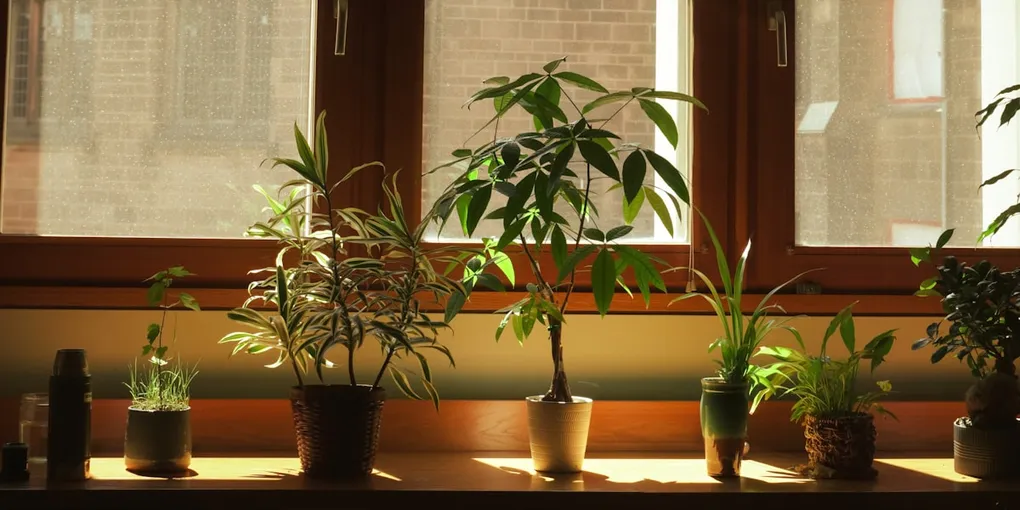
Best Plants for East-Facing Windows
An east-facing window gets direct sun for a few hours in the morning, then settles into bright indirect light for the rest of the day. Morning sun is cooler and less intense than afternoon sun — the air hasn’t heated up yet and the sun’s angle is lower — so it’s much less likely to scorch leaves than the same amount of direct light later in the day. That makes an east-facing window one of the most forgiving and versatile exposures in most homes: brighter than a north-facing window, which gets no direct sun at all, but nowhere near as intense or prolonged as a south-facing window, which can throw hours of harsh direct light in the middle of the day. Most plants that want “bright indirect light” are happy here, and quite a few that would scorch in a south window tolerate an east one without issue. See how much light do houseplants need if you’re not sure how to judge what a spot in your home actually offers, or which window direction is best for houseplants for how all four exposures compare.
Pothos
Pothos is about as adaptable as houseplants get, and an east-facing window gives it enough light to grow full and fast without any risk from the gentle morning sun. Brighter pothos varieties, like neon or golden forms, tend to hold their color best in a spot like this rather than a dimmer room.
Boston fern
Boston ferns want bright indirect light and don’t tolerate harsh direct sun well, which makes the soft morning light of an east window close to ideal. Pair it with steady humidity — see how to increase humidity for houseplants — and this is one of the better spots in the house for it.
Calathea
Calathea can be fussy about direct sun scorching its patterned leaves, but the brief, gentle morning sun from an east window is mild enough that most calathea handle it fine, especially with a sheer curtain to soften the first hour or two of light. A hotter west or south window is much more likely to cause problems.
Philodendron
Most vining philodendrons grow well in an east-facing spot — enough light to keep growth full and the leaves a healthy size, without the leaf-scorch risk that a hotter, sun-drenched window carries.
Peace lily
Peace lilies flower more reliably in brighter light than the low, indirect conditions of a north window offer, and an east-facing window’s morning sun is usually gentle enough not to bleach or scorch the leaves the way stronger afternoon sun would.
Dracaena
Dracaena is adaptable across a range of light levels, but it grows fullest and holds its leaf variegation best in bright indirect light with a little direct sun, which an east window provides without the heat buildup of a west-facing one.
Bird’s nest fern
Bird’s nest fern wants bright, indirect light and is sensitive to direct sun scorching its broad, glossy fronds. The soft morning light of an east window is usually mild enough to work, especially a few feet back from the glass rather than pressed right against it.
Chinese money plant
Chinese money plant grows compact and full in bright indirect light, and tolerates the mild direct sun of an east window well. Rotate it occasionally, since it tends to lean hard toward whatever direction the light is coming from.
Where east-facing windows fall short
An east window won’t give true sun-lovers — succulents, cacti, croton, bird of paradise — enough light intensity or duration to thrive long-term; those plants do better in a south- or west-facing window. And if a plant here is stretching, leaning hard toward the glass, or producing smaller leaves than it should, that’s usually a sign it wants more light than even a good east exposure provides.