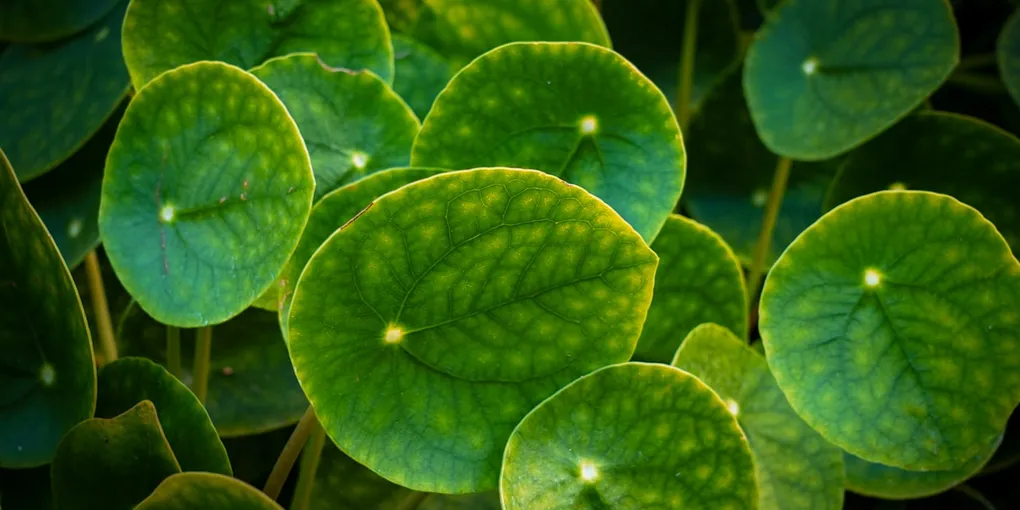
How to Care for a Chinese Money Plant
The Chinese money plant, botanically Pilea peperomioides, is instantly recognizable by its round, coin-shaped leaves balanced on thin stems like tiny green pancakes — hence the nicknames “pancake plant” and “UFO plant.” Part of its popularity comes from how easily it’s shared: a healthy Pilea throws off baby plantlets constantly, and a huge number of these plants in people’s homes started as a pup gifted by a friend rather than something bought at a store. It also stays compact enough to live happily on a windowsill or desk for years.
Light
Pilea wants bright, indirect light — an east-facing window or a spot a few feet back from a south- or west-facing one works well. What makes this plant unusual is how strongly phototropic it is: the leaves will bend and stretch hard toward whatever light source they can find, and within a week or two of neglect you’ll have a lopsided plant leaning almost sideways. Rotate the pot a quarter turn every week or so to keep growth even and the leaves arranged in a full, symmetrical circle instead of pointing all one direction. Direct, hot sun for extended periods can scorch the leaves, so keep it out of a bare south-facing window at midday.
Watering
Let the soil dry out about halfway down the pot before watering again, then water thoroughly until it runs from the drainage hole. Pilea leaves are a good visual gauge of thirst — they’ll droop and curl inward when the plant needs water, then perk back up within a few hours of a good soak. For a general framework on judging moisture by feel rather than a fixed schedule, see watering houseplants the right way. Yellowing lower leaves are the opposite problem — a sign the soil is staying wet too long between waterings and the roots are struggling.
Soil and pot
A well-draining mix matters more here than with a lot of houseplants — a standard potting soil with some extra perlite mixed in works well, and the guidance in the best soil mix for houseplants is a good starting point. A pot with a drainage hole is non-negotiable. Pilea roots are fairly unforgiving of soggy, waterlogged soil, and a pot that can’t drain is one of the fastest ways to lose this plant to rot.
Propagation
Pilea are famous in the houseplant world for producing baby plantlets, or “pups,” from the base of the main stem and sometimes right up through the soil from the roots. Once a pup has grown a few leaves and reached a couple of inches tall, it’s ready to separate — use a clean knife to cut it away from the mother plant, ideally with a bit of root already attached. From there you can pot it directly in its own soil, or root it in water first for a few weeks until you see roots forming, following the same approach covered in how to propagate houseplants from cuttings. Either method works reliably, which is a big part of why this plant gets passed from friend to friend so often.
Toxicity
Chinese money plant is non-toxic to cats and dogs, making it a safe pick if pets like to investigate your plant shelf. It’s a good option to add to a pet-safe houseplants for cats and dogs list if you’re building out a collection with curious animals around.
Common problems
Leaning or lopsided growth is the most common complaint, and it’s almost never a health issue — it’s just the plant chasing light. Get in the habit of rotating the pot a quarter turn each week and the growth will even out over time.
Curling leaves usually mean the plant is underwatered and asking for a drink. Less often, it’s a sign of too much direct sun beating on the leaves during the hottest part of the day — if watering doesn’t fix it, check whether the plant is getting scorched rather than thirsty.
No pups forming isn’t something you can force with a product or a schedule. A Pilea that isn’t producing plantlets usually just needs more light or more time to mature — plants often don’t start putting out pups until they’re a year or more old. Patience solves this one, not a change in care routine.