Best Flowering Houseplants to Grow Indoors
Most popular houseplants are grown for their leaves — a monstera or a pothos never has to flower to earn its spot on a shelf. But a handful of houseplants will genuinely rebloom indoors, year after year, without a greenhouse or specialist knowledge. Plenty of “flowering houseplants” sold at grocery stores either won’t rebloom without help or were never bred to flower indoors long-term in the first place. These will. (The RHS houseplant pages are a good next stop if you want a broader menu of flowering options than the short list below.)
African Violet
African violets (Saintpaulia) are close to the easiest reliable rebloomer on this list — a happy plant flowers in flushes almost year-round. The two things that matter: bright, indirect light (an east-facing window is close to ideal), and keeping water off the fuzzy leaves, since splashes cause spotting and a wet crown can rot the plant outright. Bottom-water in a saucer instead of pouring from above, and don’t rush to repot — African violets actually bloom best a little root-bound. Full details in how to care for an African violet.
Phalaenopsis Orchid
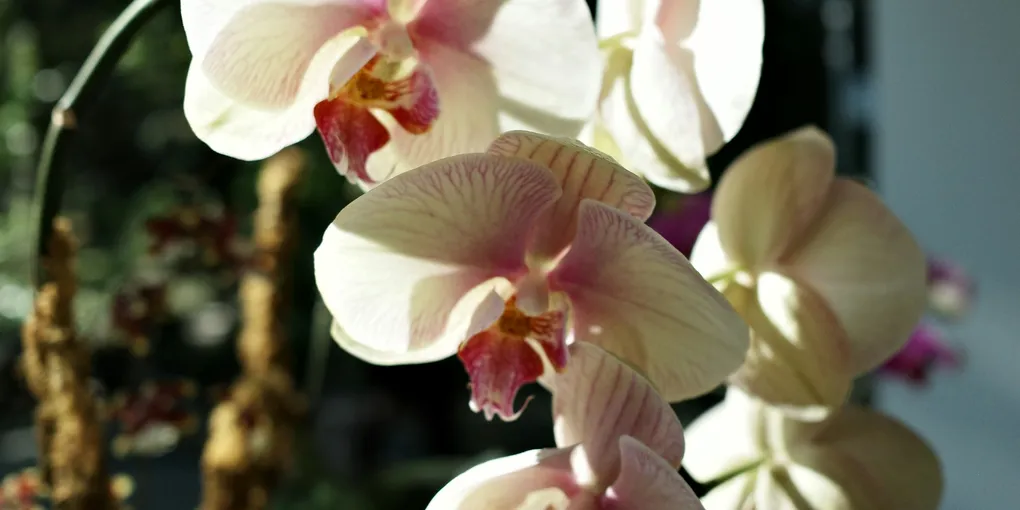
The grocery-store moth orchid (Phalaenopsis) has a reputation for being fussy that it doesn’t really deserve. Give it bright indirect light, water by soaking the roots thoroughly about once a week rather than sipping from an ice cube, and pot it in bark or moss instead of regular soil — it’s an epiphyte, and its roots need air, not dense potting mix. When the flower spike fades, cut it back to just above one of the small nodes along the stem; sometimes a new branch grows from that node and reblooms without needing a fresh spike from scratch. See how to care for a Phalaenopsis orchid for the full routine.
Anthurium
Technically the glossy red, pink, or white “flower” is a modified leaf called a spathe, not a petal — but it looks and behaves like a bloom, lasting weeks to months before fading. Anthuriums want bright indirect light and a chunky, fast-draining mix, since they’re epiphytes underneath the showy foliage. The single biggest lever for reblooming is light; a plant kept too dim will put out leaves indefinitely without ever spiking a new spathe. How to care for an anthurium covers feeding and troubleshooting a stalled plant.
Peace Lily
Peace lilies tolerate low light well enough to survive in a dim corner, but that’s also why so many never bloom — low light keeps them alive and green without ever producing the white spathes people buy them for. Move one to brighter indirect light and it flowers far more reliably. They also droop dramatically and unmistakably when thirsty, then perk back up within hours of watering, making them one of the easier plants to learn correct watering timing on. More in how to care for a peace lily.
Bromeliad
Bromeliads like Guzmania, Vriesea, and Aechmea are sold for their bold, long-lasting color, and that bloom really can last for months. The care quirk that trips people up: you water the central cup formed by the leaves, not just the soil, flushing it out every week or two so it doesn’t stagnate. One thing to know going in — each rosette flowers exactly once, then slowly declines while producing offset “pups” at the base that eventually bloom in its place. That’s normal life cycle behavior, not something you did wrong. Full care notes at how to care for a bromeliad.
Christmas Cactus
Despite the name, this is a rainforest epiphyte, not a desert succulent, and it resents being treated like one — it wants the top inch of soil to dry out between waterings, not a full bone-dry stretch. It blooms on a trigger, not luck: about 6-8 weeks before you want flowers, give it 12-14 hours of uninterrupted darkness each night along with bright light during the day, plus cooler nighttime temperatures if you can manage it. Get that right and it reblooms on schedule, often for decades. See how to care for a Christmas cactus for the full trigger routine.
Hoya
Hoyas are grown as much for their thick, waxy leaves as for their clusters of small, star-shaped, often fragrant flowers, called umbels. They’re semi-succulent, so let the soil dry out almost completely between waterings — overwatering is a bigger risk than underwatering. Give a hoya as much bright indirect light as you can without scorching the leaves and be patient, since most varieties need a couple of years to mature before flowering at all. Once blooms start, don’t cut off the old flower stalks — hoyas rebloom from the same spurs year after year. Details in how to care for a hoya.
Kalanchoe
Kalanchoe is a compact succulent grown for tight clusters of small flowers in red, orange, pink, or yellow that can last a month or more. It wants bright light — a few hours of direct sun is fine — and, like most succulents, a full dry-out between waterings; soggy soil rots the roots faster than almost anything else will kill it. The catch is reblooming: kalanchoe sets buds in response to long, uninterrupted nights, the same trigger that drives a Christmas cactus. Without 12-14 hours of darkness a night for several weeks, most indoor kalanchoes just hold their leaves and never flower again after the first grocery-store bloom fades.
Bird of Paradise (bonus, with a caveat)
Bird of paradise is grown almost entirely for its huge, paddle-shaped leaves, and it deserves an honest caveat here: most indoor plants never flower at all, and the ones that do usually need several years of maturity plus more direct sun than a typical home window provides. If yours sits in front of an unobstructed south- or west-facing window getting hours of strong light a day, a bloom is possible eventually — just don’t buy one expecting the dramatic orange-and-blue flowers anytime soon. Treat it as a bonus, not the reason to get the plant. See how to care for a bird of paradise for what it needs as a foliage plant.
Light is the real bottleneck
Almost every plant on this list shares the same failure mode: it survives in low light but simply won’t flower there. If your rooms don’t get much natural light, it’s worth reading how much light houseplants actually need before assuming a plant is a dud — and a grow light is often the difference between a plant that just holds on and one that actually reblooms. Get the light right first; everything else here is a secondary fix.