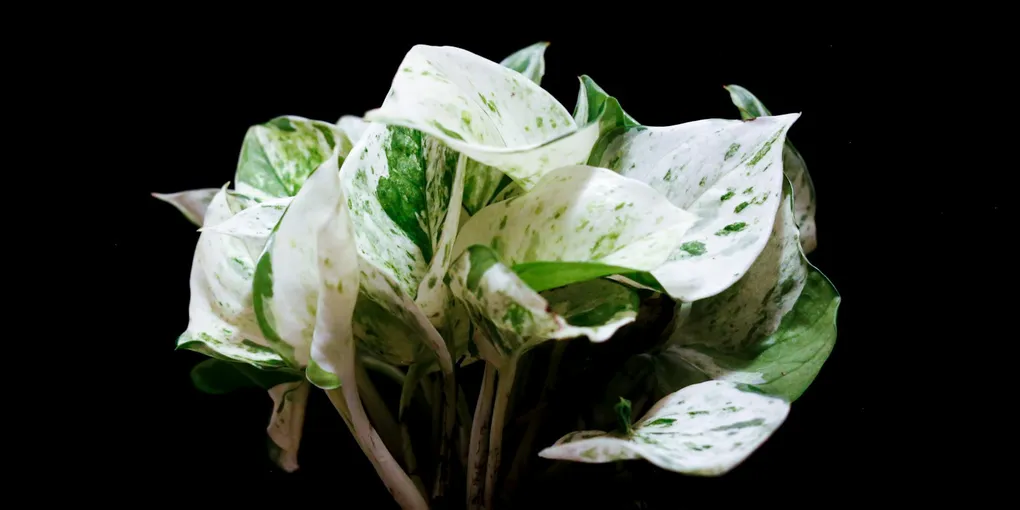
How to Care for a Marble Queen Pothos
Marble Queen pothos (Epipremnum aureum ‘Marble Queen’) is grown for its irregular white and cream marbling, which can cover half or more of each leaf — more variegation than you’ll find on a Golden Pothos or a neon pothos. That heavy white patterning looks great, but it comes at a cost: white leaf tissue has no chlorophyll and can’t photosynthesize, so Marble Queen needs more light and grows more slowly than plainer pothos varieties. Everything else about its care is standard pothos routine.
Light
This is the one place Marble Queen really diverges from a typical Golden Pothos. Because so much of each leaf is white rather than green, the plant has less usable leaf surface to generate energy from, and it needs brighter indirect light to compensate. A spot a few feet from an east-facing window, or bright but filtered light near a south- or west-facing one, works well. Give it too little light and two things happen: growth slows to a crawl, and new leaves come in with progressively less white and more green as the plant reverts to the most efficient way to photosynthesize with what it’s got. Direct, intense sun can still scorch the leaves, so aim for bright and indirect rather than a spot with hours of direct midday sun. See how much light do houseplants need if you’re not sure what your space provides.
Watering
Let the top 1-2 inches of soil dry out before watering again — the same forgiving routine as any pothos. Marble Queen tolerates a missed watering or two without much drama; the leaves droop noticeably when thirsty, which is your cue, and they recover within hours of a good soak. It’s much less tolerant of soil that stays wet, so err on the side of underwatering rather than sticking to a fixed schedule. For a full method on judging by feel, see watering houseplants the right way.
Soil and pot
A standard, well-draining potting mix is fine — Marble Queen isn’t picky about soil composition. What matters more is a pot with a drainage hole, so water doesn’t sit around the roots and encourage rot.
Toxicity
Marble Queen pothos is mildly toxic to cats and dogs if chewed, causing oral irritation and stomach upset. Keep it out of reach of curious pets, or see pet-safe houseplants for cats and dogs for alternatives.
Common problems
New leaves coming in mostly green instead of marbled white is the defining problem with this cultivar, and it’s almost always a light issue. Because variegated tissue can’t photosynthesize, a plant that isn’t getting enough light responds by producing greener, more efficient leaves. Moving it to a brighter spot won’t change leaves that have already grown in, but it should restore more white marbling on new growth. If one specific vine is consistently green while the rest of the plant stays patterned, that’s usually a reverted growing point rather than a light problem — prune that vine back to the last leaf that still shows variegation. See why is my pothos losing its variegation for a closer look at both causes.
Slower growth than you’d expect from a “pothos” is normal for Marble Queen. All that white tissue means less photosynthetic capacity than a Golden Pothos or other mostly-green cultivar, so don’t assume something’s wrong just because it fills out a pot more slowly.
Yellow leaves usually point to overwatering rather than a light or variegation issue — soil that’s staying wet between waterings instead of drying out. Cut back on frequency and confirm the pot actually drains.
Legginess and sparse vines happen when the plant isn’t getting enough light and stretches out looking for more, with leaves spaced far apart instead of growing bushy. Moving it brighter helps going forward; for vines that are already leggy, trim back to just above a node to force bushier regrowth. See how to fix a leggy, stretched-out houseplant for the full approach. Rooting the trimmed cuttings is easy — see how to propagate houseplants from cuttings — and is a good way to fill the pot back in or start more plants for a variegated collection.