How to Fix a Leggy, Stretched-Out Houseplant
A plant that’s grown noticeably taller or longer lately isn’t necessarily thriving. If the new growth is thin, spaced far apart, and leaning hard toward whatever light it can find, that’s legginess — and it’s a light problem, not a growth spurt.
What “leggy” actually looks like
- Long gaps between leaves: the stem between one leaf and the next (the internode) has stretched out much farther than it used to, leaving visible bare stem instead of dense foliage.
- Smaller, paler new leaves: each new leaf is a little weaker than the last, since the plant is spending its energy on stretching rather than building full-sized foliage.
- Stems leaning or reaching: growth curves noticeably toward a window or lamp instead of growing upright and even on all sides.
One long internode isn’t a crisis. A plant that’s mostly stem with a few leaves clustered at the tip is.
Why it happens
Legginess is almost always a light problem. When a plant doesn’t get enough light, it grows rapidly upward or outward searching for more instead of putting energy into compact, full growth. It’s the same mechanism as a seedling stretching toward a windowsill — the plant is prioritizing reaching a better light source over building sturdy, leafy structure. A handful of naturally trailing plants will also lengthen with age regardless of light, but if you’re seeing sparse, pale growth alongside the stretching, light is the cause to rule out first.
How to fix it
Move it to brighter light, gradually. A plant that’s been stretching in low light has leaves acclimated to that dim environment, and moving it straight into direct sun will scorch them. Shift it to a brighter spot in stages over a week or two — a little closer to the window each time — rather than making the move all at once.
Prune back the leggy stems. Cutting back stretched growth removes the weak, sparse section and encourages the plant to branch out from lower nodes instead of continuing to grow in one thin line. Most houseplants respond to a hard prune with several new shoots rather than one, which is what gives you a fuller-looking plant afterward.
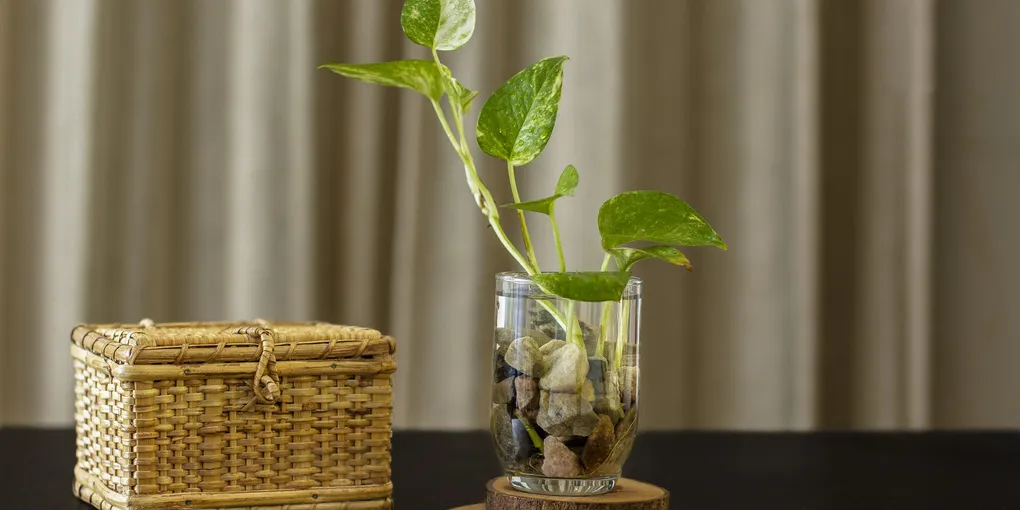
Propagate what you cut off. Don’t toss the trimmings — most leggy stems root easily in water or soil. Propagating houseplants from cuttings is the easiest way to turn a stretched-out stem into a second, fuller plant instead of wasting the growth.
Rotate the plant regularly. A plant that always faces the same direction toward its light source will keep growing lopsided, since only the side facing the window gets enough light to grow evenly. A quarter turn every week or two keeps growth balanced on all sides instead of concentrated toward one window.
When natural light isn’t enough
If you’ve moved the plant as close to a bright window as your space allows and it’s still stretching, the room itself doesn’t have enough light for that plant — no amount of repositioning will fix that. At that point, a grow light is the honest fix, not a stopgap. This is especially common in winter, in rooms with north-facing windows, or with plants kept several feet back from the nearest light source.
Preventing it going forward
Once a plant is back to full, compact growth, keep it that way by rotating it on a regular schedule and paying attention to how far it sits from its light source. A plant that’s fine today can start stretching a few months later if it’s gradually pushed farther from the window by furniture rearranging or seasonal light changes. Checking in on it occasionally is enough to catch legginess early, before it’s grown into several feet of bare stem.