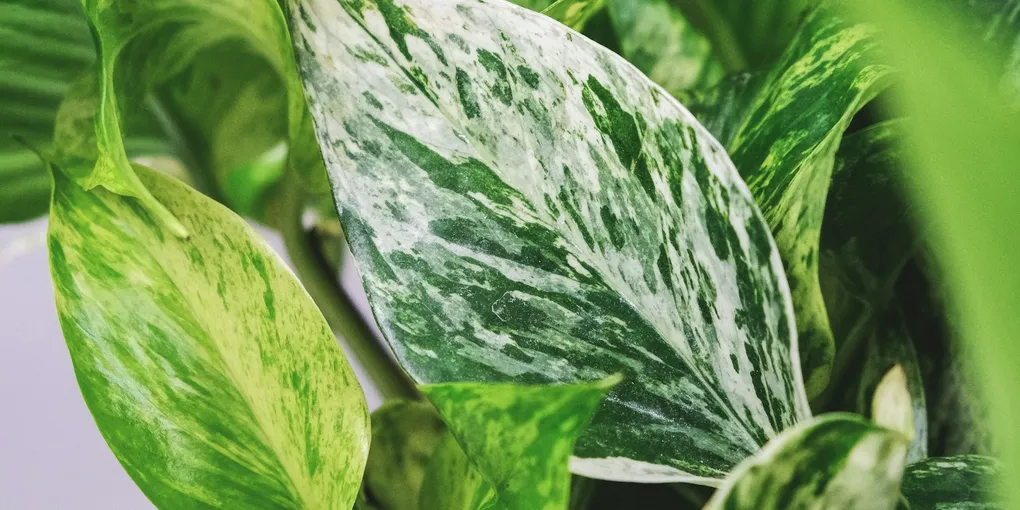
Best Variegated Houseplants to Start Collecting
Variegation is patches of leaf tissue that lack chlorophyll, the pigment that makes leaves green and does the actual work of photosynthesis. It’s usually a genetic mutation, sometimes stable and heritable, sometimes not, and it shows up as white, cream, or yellow sections mixed into the normal green. Because those pale patches can’t photosynthesize, a variegated plant is doing the same job with less usable leaf surface than its solid-green form, which is why variegated plants generally want more light and grow more slowly than their all-green counterparts. That single fact explains most of what’s different about caring for them.
Start here: affordable and easy to find
These are widely sold, don’t cost much more than their solid-green counterparts, and forgive beginner mistakes — a good place to get a feel for variegated care before spending real money.
- Variegated pothos (Marble Queen or Manjula) — Pothos is already one of the most forgiving houseplants around, and the variegated cultivars keep most of that toughness. Marble Queen has crisp white-and-green marbling; Manjula adds curled leaf edges and creamy patches. Both need noticeably brighter light than plain green pothos to keep the variegation from fading back to solid green.
- Neon Pothos — Not variegated in the patchy sense, but its uniform chartreuse color makes a good stepping stone if you want something eye-catching without the pickier light needs of true variegation.
- Philodendron Brasil — A heartleaf philodendron with a bright lime stripe down the center of each leaf. Easygoing, fast-growing, and one of the most forgiving variegated plants you can buy.
- Variegated spider plant — The classic striped spider plant most people already picture when they hear the name. Tolerant of a wide range of light and still produces plantlets you can propagate for free, same as the solid-green form.
- Snake plant ‘Laurentii’ — A variegated cultivar of the same snake plant species covered in our general care guide, with yellow margins running along each leaf. Just as tolerant of low light and irregular watering as a standard snake plant, which makes it one of the few variegated plants that doesn’t demand extra light to look right.
Once you’re hooked: collector-grade plants
These cost significantly more, usually because they’re slower to propagate and stay in higher demand than they are in supply. Worth knowing about once you’ve got a feel for how variegated plants behave, not necessarily a place to start.
- Monstera Albo — Large white sectors on Swiss-cheese-style leaves, and one of the most sought-after (and priciest) houseplants in circulation. Needs bright, consistent light and careful pruning to keep the variegation balanced.
- Monstera Thai Constellation — A stable, speckled variegation pattern that, unlike Albo, is much less prone to reverting to solid green, which is part of why it commands a premium.
- Pink Princess Philodendron — Dark green-black leaves splashed with hot pink. The pink sections are especially light-hungry and prone to reverting if the plant doesn’t get enough bright light.
What actually changes with care
More light, mostly. Variegated plants need brighter conditions than their solid-green form to keep producing enough energy to grow — a spot that suited a plain pothos may leave a Marble Queen pale, slow, or dropping its variegation altogether. Watch for reversion: if a plant sends out a fully green leaf, that shoot is out-competing the variegated growth for resources, and pruning it off encourages the plant to keep producing variegated leaves instead. Otherwise, watering and soil needs mostly track the plain-green version of the same species — a variegated pothos still wants to dry out between waterings just like a regular one.