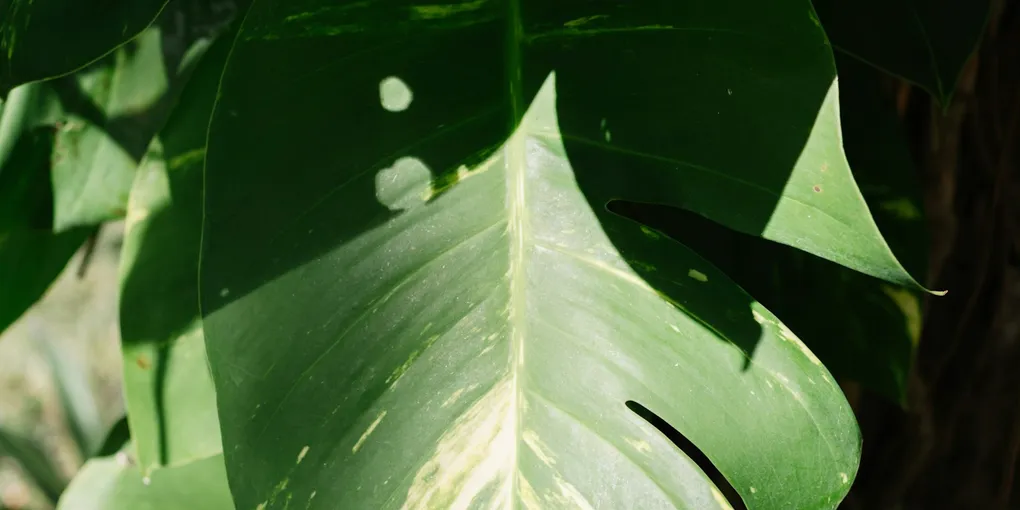
How to Care for a Monstera Albo
Monstera Albo — short for Monstera deliciosa ‘Albo Variegata,’ sometimes labeled Monstera Albo Borsigiana — is a variegated form of the standard Monstera deliciosa with irregular white or cream patches splashed across its green, fenestrated leaves. The variegation is a genetic mutation that knocks out chlorophyll production in the affected tissue, which is exactly why this plant costs so much more and demands more care than its all-green parent: pure white leaves and sections can’t photosynthesize at all, so the plant is effectively running on a smaller solar panel than a same-sized green Monstera. Every care decision here is really about protecting that trade-off.
Light
Bright, indirect light is non-negotiable. A few feet back from a south- or west-facing window, or closer to an east-facing one, is ideal. Because the white sections can’t photosynthesize, an Albo needs more total light reaching its leaves than a green Monstera just to keep up the same growth rate — but direct, hot sun will scorch the thin white tissue faster than it scorches green tissue, since there’s no chlorophyll there to help dissipate the energy. Rotate the plant occasionally so growth doesn’t lean hard toward one side chasing light.
Watering
Water when the top 2-3 inches of soil are dry, then water thoroughly until it runs from the drainage hole. White leaves and stem sections use less water than green ones since they aren’t running photosynthesis, so an Albo can be slightly more sensitive to overwatering than a standard Monstera — soggy soil around already-slower roots is a fast route to rot. See watering houseplants the right way for how to judge this by feel rather than a fixed schedule.
Soil and pot
Use a chunky, fast-draining aroid mix — potting soil cut with orchid bark, perlite, and a bit of charcoal. See the best soil mix for houseplants or how to make a chunky aroid potting mix for ratios. A pot with a drainage hole is essential. Keep the pot sized close to the root ball rather than sizing up aggressively, since a large volume of soil holds moisture longer than the roots can use.
Humidity
Higher humidity than an average home offers — 50-60% — encourages fuller, glossier growth and reduces crispy edges on the white sections, which scorch and brown more easily than green tissue. See how to increase humidity for houseplants for practical ways to raise it.
Support
Like any Monstera, an Albo is a climber that sends out aerial roots to grip a surface as it grows. Giving it a moss pole to climb encourages larger, more mature leaves with better fenestration, the same way it does for a standard Monstera deliciosa.
Variegation stability and pruning
Variegation on an Albo isn’t fixed — it can shift leaf to leaf, and a stem can occasionally revert to fully green or, less commonly, push a leaf with so much white it has almost no green tissue left to sustain it. A fully white leaf will eventually die back because it can’t photosynthesize enough to support itself; that’s expected, not a care failure. If a stem reverts to solid green and you want to preserve variegation elsewhere on the plant, prune the reverted growth back to a node below the last variegated leaf — the green stem will otherwise grow faster than the variegated sections and can take over the plant’s energy. For propagating cuttings, see how to propagate houseplants from cuttings; choose a cutting with a mix of green and white on its leaf to give the new plant a fighting chance.
Toxicity
Monstera Albo is toxic to cats and dogs — it contains calcium oxalate crystals that cause oral irritation, drooling, and swelling if chewed. Given the price of most Albo plants, keeping it well out of reach of curious pets is doubly worth doing.
Common problems
All-white or mostly-white new leaves struggle to support themselves and often stall or die back. If a stem keeps pushing leaves with little to no green, prune it back to encourage growth from a node with more chlorophyll-bearing tissue.
Brown, crispy patches on white sections are usually sun scorch, since white tissue burns more easily than green. Move the plant back from direct sun even if the green portions look fine.
Reverting to solid green happens when a stem’s growing point loses the variegated genetic sector. It’s permanent on that stem — prune it out if you want to keep the plant’s energy going toward variegated growth instead.
Slow growth compared to a green Monstera deliciosa is normal and expected, not a sign of a problem — less chlorophyll means less total photosynthesis, so temper your growth-rate expectations accordingly.
Yellowing leaves usually point to overwatering, same as any Monstera — let the soil dry out further before your next watering and confirm the pot drains freely.