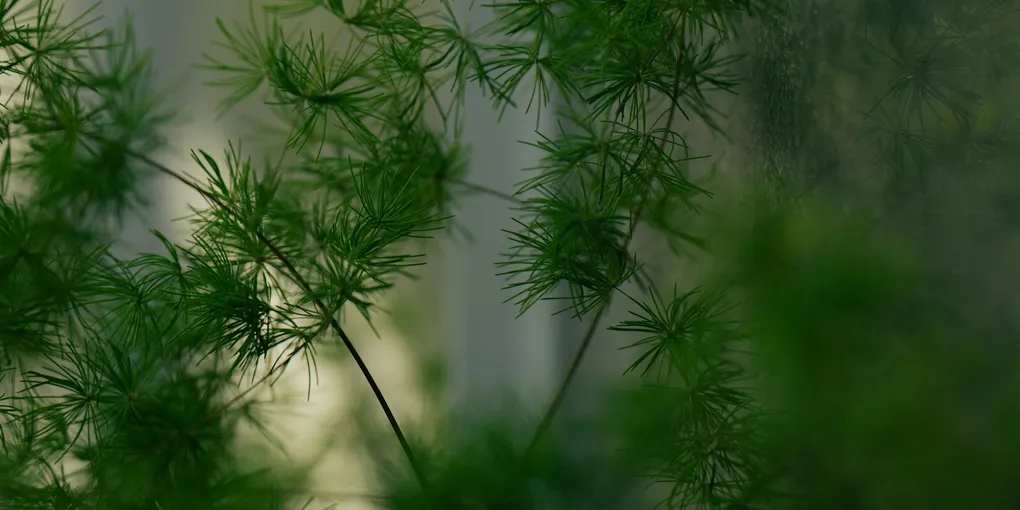
How to Care for an Asparagus Fern
Asparagus fern (Asparagus setaceus or Asparagus densiflorus ‘Sprengeri’) gets its name from its lacy, needle-like foliage, but it isn’t a fern at all. It’s a member of the Asparagaceae family, more closely related to edible asparagus than to a Boston fern or a maidenhair fern. That distinction explains why this plant behaves so differently from the true ferns it’s named after: underneath the soil it stores water in thick, tuberous roots, giving it a real buffer against dry spells that would stress out most actual ferns.
Light
Bright, indirect light keeps the foliage dense and full. Asparagus fern also tolerates a few hours of direct morning sun better than most true ferns do, though hot afternoon sun will bleach or scorch the needle-like foliage. It will survive in lower light, but growth thins out and the plant loses the lush, full look it’s grown for. For general guidance on matching plants to the light you’ve actually got, see how much light do houseplants need.
Watering
Let the top inch or two of soil dry out between waterings. This is the biggest way asparagus fern diverges from its true-fern namesakes: thanks to its water-storing tuberous roots, it handles a missed watering far better than a Boston fern or maidenhair fern would. That said, it isn’t a succulent - prolonged drought still causes significant needle drop, and foliage doesn’t regrow on bare stems, so a dried-out plant ends up permanently sparser rather than bouncing back. Soggy soil is just as much of a problem, since it rots the tuberous roots. For the general approach to judging soil moisture by feel, see watering houseplants the right way.
Soil and pot
Use a well-draining potting mix - a standard houseplant blend works, ideally with some perlite mixed in to keep water from pooling around the roots. Because its roots are thick, fleshy tubers, asparagus fern fills a pot faster than you might expect and actually prefers being slightly root-bound rather than repotted constantly; size up only once roots are visibly crowding the pot or pushing through the soil surface. Always use a pot with a drainage hole, since standing water is what actually kills this plant, not underwatering.
Humidity
Asparagus fern prefers above-average humidity and gets crispy needle tips in very dry air, but it’s noticeably more tolerant of average home humidity than true ferns are - you don’t need to treat it as a bathroom-only plant the way you might a maidenhair fern. A pebble tray or occasional misting helps in winter when heating dries out the air; for a plant that’s really struggling, see how to increase humidity for houseplants for fixes more effective than misting alone.
Toxicity
This is where asparagus fern breaks sharply from most plants people call “ferns.” True ferns are almost all non-toxic, which is part of why a Boston fern is a common pick for pet owners. Asparagus fern is the exception: it’s toxic to cats and dogs. The small berries it sometimes produces are the biggest risk if ingested, causing vomiting and diarrhea, and the sap can irritate skin on contact, leading to redness or a rash in sensitive pets (and people). Keep it out of reach of curious animals, or choose from this list of pet-safe houseplants instead if your household needs everything to be pet-safe.
Common problems
Yellowing and needle drop is most often a response to underwatering that’s gone on too long - the drought tolerance from those tuberous roots has limits. It can also happen from overwatering, so check that the soil isn’t staying wet before assuming the plant needs more water.
Brown, dry needle tips point to low humidity or a buildup of mineral salts from tap water. Letting tap water sit out overnight before using it, or flushing the pot thoroughly every couple of months, helps prevent salt buildup.
Bare, leggy stems with foliage only at the tips happen with age or insufficient light, since older stems don’t regrow needles once they’ve dropped. Cutting bare stems back to the base encourages fresh growth from the crown instead of leaving thin, straggly stems in place.
Sudden, heavy needle shed after a move or repotting is a stress response common to many houseplants after a change in environment. As long as the tuberous roots are healthy, new growth typically resumes within a few weeks.
Once you treat it as the drought-tolerant, semi-succulent relative of asparagus that it actually is - rather than as a delicate true fern - asparagus fern is a forgiving, fast-growing plant that fills out a hanging basket or shelf with soft, feathery texture few other houseplants can match.