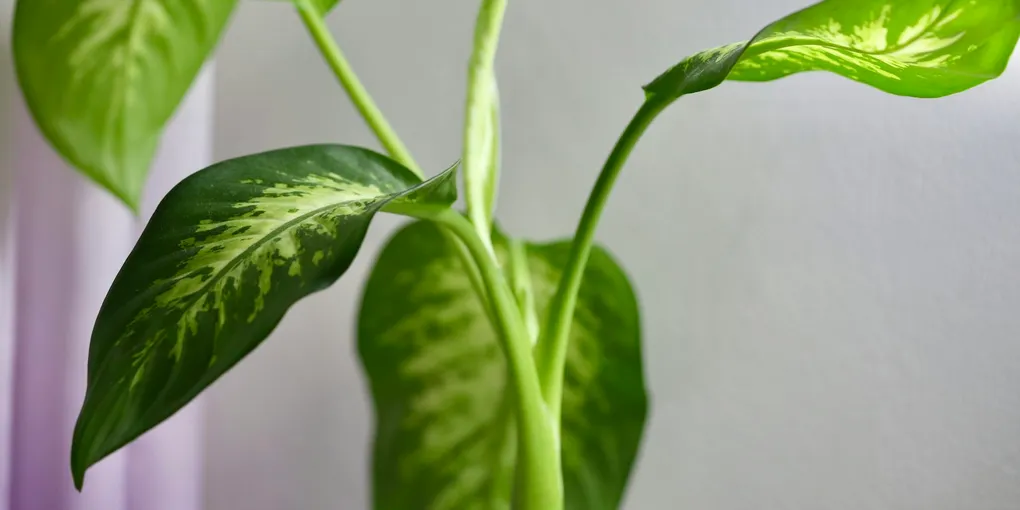
How to Care for a Dieffenbachia (Dumb Cane)
Dieffenbachia gets its common name, dumb cane, from what happens if you bite into it — a temporary inability to speak caused by swelling in the mouth and throat. That’s not a reason to avoid the plant, but it is the single most important thing to know before bringing one home, especially if you have kids or pets. Past that, dumb cane is one of the easier large-leafed houseplants to keep: it’s a fast grower with bold, splashy variegation in green, cream, and white, and it tolerates the kind of inconsistent care that would stress out fussier aroids.
Light
Dieffenbachia does best in bright, indirect light — a spot near an east-facing window, or a few feet back from a south- or west-facing one. It tolerates medium light reasonably well and will survive in dimmer corners, but variegation is the tradeoff: the less light it gets, the more the white and cream patterning fades back toward solid green, since the plant has less need to produce non-photosynthesizing tissue when light is scarce. If you bought a heavily variegated cultivar and want it to stay that way, give it more light, not less. Avoid direct sun, which will scorch the leaves — the same balance you’d strike with a philodendron or pothos.
Watering
Let the top inch or two of soil dry out before watering again, then water thoroughly until it runs from the drainage hole. Dieffenbachia is sensitive in both directions — it doesn’t want to sit in soggy soil, but it also doesn’t like going bone-dry for extended periods, which shows up as drooping and curling leaves. Check with a finger rather than watering on a fixed schedule; see watering houseplants the right way for how to judge this by feel. If you’re trying to figure out whether a struggling plant has too much or too little water, overwatering vs. underwatering walks through the symptoms side by side.
Soil and pot
A well-draining potting mix is essential — standard potting soil cut with perlite works well, or a mix labeled for aroids. What matters most is that water moves through it and doesn’t pool at the bottom, so always use a pot with a drainage hole. Dieffenbachia’s roots are prone to rot in compacted, slow-draining soil, and that risk is a bigger threat to the plant than an occasional missed watering.
Humidity
Dieffenbachia comes from humid tropical forests in Central and South America and prefers moderate to higher humidity than most homes provide naturally. It will tolerate average household humidity without major issues, but the leaf edges are the first place stress shows up when the air is persistently dry. Grouping plants together, running a pebble tray, or using a humidifier all help. How to increase humidity for houseplants covers the options that actually make a measurable difference versus the ones that don’t.
Toxicity
This is the plant’s defining trait. Dieffenbachia contains calcium oxalate crystals throughout its tissue, and chewing or biting into a leaf or stem releases them into the mouth and throat, causing painful swelling, burning, and — in some cases — a temporary inability to speak, which is where the name “dumb cane” comes from. It’s toxic to both people and pets if ingested, and severe cases can involve swelling serious enough to affect breathing or swallowing. The National Capital Poison Center (poison.org) covers dieffenbachia exposure and what to do if someone chews on one. Keep it well out of reach of small children and curious cats or dogs, and if you’re building a pet-friendly plant collection, pet-safe houseplants for cats and dogs has safer alternatives that share a similar look.
Common problems
Yellow lower leaves are usually a sign of overwatering — soil that’s staying wet too long between waterings. It’s normal for a Dieffenbachia to shed its oldest bottom leaves occasionally as it grows, but if several yellow at once, let the soil dry out further and check that the pot drains. See why plant leaves turn yellow for other causes if that doesn’t resolve it.
Brown, crispy leaf edges point to low humidity or dry indoor air, especially during winter when heating systems pull moisture out of a room. Raise the humidity around the plant before assuming anything else is wrong.
A bare, leggy cane with leaves clustered at the top is just how mature Dieffenbachia grows — older plants naturally lose their lower leaves and end up with a tall, woody-looking cane topped by foliage. If you want a fuller-looking plant rather than a tall stalk, you can cut the cane back hard, even down to a few inches of bare stem, and new growth will sprout from dormant nodes along what’s left. It looks drastic for a few weeks, but Dieffenbachia recovers from this reliably. For the underlying cause and other fixes, see how to fix a leggy houseplant.
Give a Dieffenbachia bright indirect light, water it once the topsoil dries, keep the humidity reasonable, and don’t let kids or pets near the leaves — it’s a forgiving, fast-growing plant once those basics are in place.