Powdery Mildew on Houseplants: What It Is and How to Treat It
A white, flour-like dusting across a plant’s leaves is one of the more visually alarming problems a houseplant can develop, but it’s also one of the more treatable ones once you know what’s causing it and why it showed up in the first place.
What powdery mildew is
Powdery mildew is a fungal infection that grows directly on a plant’s leaves, stems, and sometimes flower buds, feeding on the plant tissue itself rather than on anything left behind by a pest. That’s the key difference from sooty mold, which is black rather than white and grows on the sugary honeydew that sap-sucking insects like aphids and mealybugs leave behind — sooty mold is a secondary problem that follows a pest infestation, while powdery mildew is a direct fungal attack on the plant. The two are easy to tell apart by color alone: powdery mildew is white to gray, sooty mold is black.
How to identify it
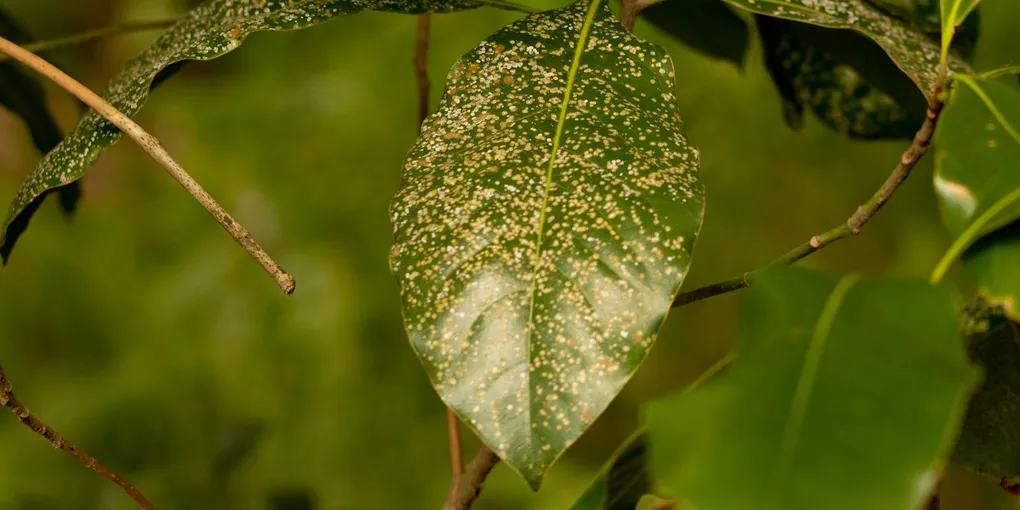
Powdery mildew typically starts as small, roughly circular white or grayish patches, most often on the upper surface of leaves. Left untreated, those patches spread and merge until they can cover most of a leaf in a dusty, flour-like coating. As the infection progresses, affected leaves often start to yellow, curl, or become distorted, and heavily infected leaves may eventually drop. Unlike a lot of leaf discoloration, the powdery texture is genuinely dust-like — you can often smudge or wipe some of it away with a finger, which isn’t true of most other leaf spotting or discoloration.
Why it shows up
Powdery mildew fungi thrive in a specific combination of conditions: poor air circulation combined with high ambient humidity. Counterintuitively, the fungus doesn’t need standing water on the leaf surface to establish itself the way many other fungal diseases do — it actually favors dry leaf surfaces sitting in humid, stagnant air, which is part of why it can show up even on plants you’re not overwatering. Houseplants crowded closely together with little airflow between them are especially prone, since stagnant air around the foliage is exactly the environment this fungus wants. If you’ve recently increased humidity around a group of plants without also improving air movement, that’s a common setup for an outbreak.
How to treat it
Isolate the affected plant as soon as you notice it. Powdery mildew spreads through airborne spores, so keeping an infected plant away from your other houseplants limits how far it can travel while you treat it.
Remove heavily affected leaves. Snip off leaves that are mostly covered in the white coating and discard them in the trash rather than a compost pile, since composting can let spores survive and spread later.
Treat remaining mild cases. A diluted neem oil spray or a horticultural fungicide labeled for powdery mildew both work well on lighter infections. A diluted baking soda and water solution (roughly a teaspoon of baking soda per quart of water, with a drop of mild soap to help it stick) is also a commonly used, low-cost treatment for mild cases — spray it on affected and nearby healthy leaves and reapply every week or so until the mildew is gone.
Improve air circulation immediately. Treatment won’t hold if the conditions that caused the outbreak don’t change. A small fan run for part of the day, or simply spacing plants further apart, makes a meaningful difference in how hospitable the air around your plants is to this fungus.
How to prevent it coming back
Keep plants spaced with some room between their leaves rather than packed tightly together, and make sure any humidity boost you’re providing — a pebble tray, a humidifier, a grouped arrangement — is paired with decent airflow rather than trapping stagnant, humid air around the foliage. Periodically wiping down leaves as part of general plant hygiene also helps, since it disturbs the kind of dust and buildup that can make leaves more hospitable to fungal spores landing on them. If powdery mildew keeps returning on the same plant despite treatment, the underlying airflow or spacing issue is almost always still unresolved rather than the fungus being unusually persistent. For a broader look at what else might be affecting your plants, see common houseplant pests and how to get rid of them.