How to Tell if a Houseplant Is Root Bound (and What to Do About It)
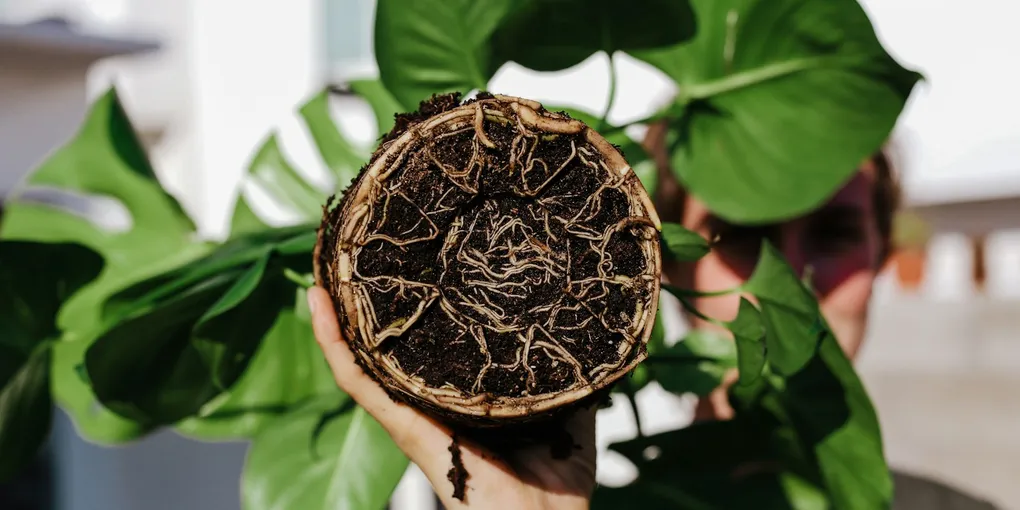
“Root bound” just means the roots have filled every bit of available soil and started circling the inside of the pot looking for somewhere else to go. It’s not automatically bad — for some plants it’s the preferred state — but for others it’s the reason growth has stalled or watering has gotten weirdly hard to get right. Here’s how to tell which situation you’re in.
The signs to look for
- Roots visible through the drainage holes. If you can see roots poking out the bottom of the pot, they’ve already run out of room inside.
- Roots circling the surface of the soil. A tangle of roots sitting on top of the soil, rather than soil covering them, means the root mass below is packed tight enough to push growth upward instead of outward.
- Water runs straight through without absorbing. When you water and it pours out the bottom almost immediately instead of soaking in, there’s more root than soil in the pot to actually hold moisture.
- The plant dries out much faster than it used to. The same watering schedule that worked for months suddenly isn’t enough, because roots have replaced the soil that used to store water between waterings.
- Growth has slowed or stopped despite otherwise consistent light, water, and fertilizer. A plant with no room left for new roots often has no room left to support new leaves either.
- The plant is being pushed up out of its pot, sitting noticeably higher than it did when you last potted it, as the root mass expands beneath it with nowhere else to go.
Any one of these on its own is worth noting. Two or three together are a good indication it’s time to actually check.
How to check by sliding the plant out
Signs from the outside are a guess — looking at the root ball directly is the only way to know for sure.
- Water the plant a day or so beforehand if the soil is bone dry; damp soil releases from the pot more easily and roots handle the process better than when brittle.
- Tip the pot sideways and gently squeeze the sides to loosen the root ball, rather than pulling on the stem.
- Slide the plant out and look at what you’re working with. Soil that’s still visible between roots means there’s room left. A solid mass of roots with little or no visible soil, tightly circling the shape of the pot, is the definition of root bound.
This is also the moment to check the roots for anything darker or mushier than you’d expect — if you spot that instead of a healthy tangle, check for root rot before doing anything else, since rot changes what the plant actually needs next.
When root bound is actually fine
Plenty of houseplants tolerate — or even prefer — being a little snug in their pot. A spider plant often flowers and produces more babies when its roots are slightly crowded. Snake plants and ZZ plants both store water in thick rhizomes and roots, and being pot-bound just means less excess soil around them holding moisture they don’t need — which lowers the risk of rot rather than raising it. If one of these is showing mild signs of being root bound but is still growing normally and doesn’t need watering more than once a week or so, it’s fine to leave it alone.
The plants worth watching more closely are fast growers that rely on a steady soil volume to support new growth — pothos, philodendron, monstera, and similar vining or broad-leaved plants. For these, root bound usually shows up as a real slowdown rather than a shrug-worthy inconvenience.
What to do about it
If the plant is drying out too fast, growth has clearly stalled, or it’s a variety that doesn’t benefit from being snug, it’s time to size up. Measure the root ball you just exposed and choose a new pot that matches it — how to choose the right pot size for houseplants covers how much bigger to go and why oversizing causes its own problems. Once you have the right pot, loosen any tightly circling roots at the bottom and sides so they grow outward instead of continuing to spiral, then follow the full process in how to repot a houseplant without stressing it out for the steps after that, including how long to wait before fertilizing and what aftercare to expect.
If the plant is one that tolerates being root bound and is still growing well, you can also just leave it in its current pot. Root bound isn’t a problem to fix on a schedule — it’s a condition to check for, and only act on when the signs say the plant actually needs the room.