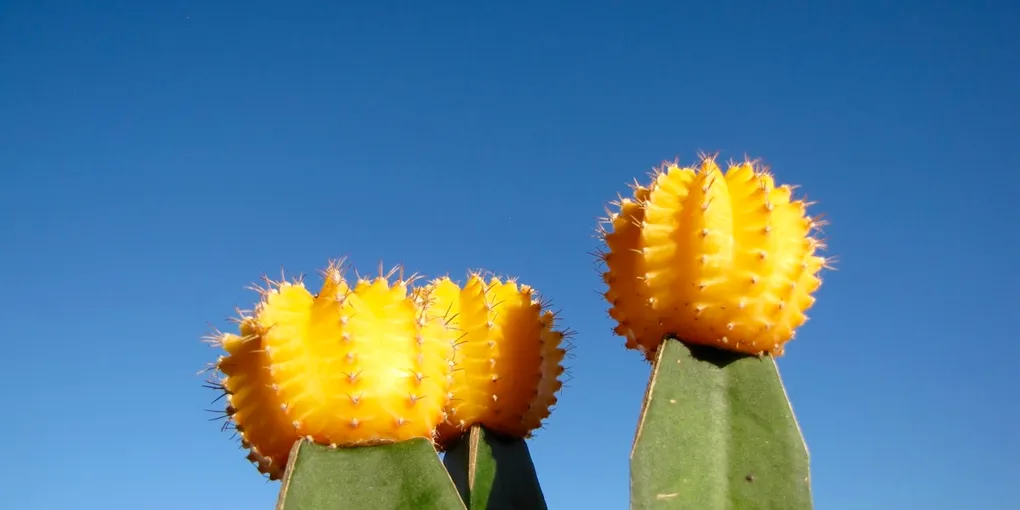
How to Care for a Moon Cactus
Moon cactus (Gymnocalycium mihanovichii) is the small, brightly colored globe you see stacked in red, orange, yellow, or hot pink at almost every garden center. What most people don’t realize when they buy one is that it’s actually two cacti grafted together — and understanding that graft is the key to keeping the plant alive.
It’s a grafted plant, not a single species
The colorful top ball is a mutant form of Gymnocalycium that lacks chlorophyll, the pigment plants use to photosynthesize. On its own, it can’t produce any energy and would die quickly. To sell it as a houseplant, growers graft it onto a green, chlorophyll-producing rootstock cactus (commonly a Hylocereus, the same genus dragon fruit comes from), which does all the photosynthesizing for both halves. The visible seam where the two meet is the graft union, and it’s the single most important spot on the plant to watch.
Light
The green rootstock needs decent light to keep photosynthesizing enough to support itself and the colorful top riding on it. Bright, indirect light is the safest choice; a few hours of gentler direct morning sun is fine, but intense afternoon sun can scorch both the rootstock and the delicate colored top. If light is too low for too long, the rootstock weakens and the whole plant suffers, so don’t push it into a dim corner the way you might get away with for a snake plant. A spot near a bright window, out of the harshest direct rays, works well — see do you need a grow light for houseplants if your available light is limited.
Watering
Water like a true desert cactus: let the soil dry out completely, then water thoroughly and let it drain. Moon cactus is unusually prone to rot at the graft union specifically, since that seam is where moisture and fungal or bacterial issues most easily take hold. Erring dry is always safer than erring wet here. In fall and winter, cut back further, since growth slows and the plant needs even less water than it does in spring and summer.
Soil and pot
Use a fast-draining cactus or succulent mix, never a standard potting mix that holds moisture — see the best soil mix for houseplants for how to build or buy one. A pot with a drainage hole is essential. Terracotta is a good choice over plastic, since its porous walls help excess moisture evaporate rather than linger around the roots.
The graft doesn’t last forever
Even with good care, most moon cactus grafts eventually fail — the union can weaken or the colorful top can simply outlive what the rootstock can support, often after a few years. This is normal and not necessarily a sign you did something wrong. If you catch a failing graft early, some growers re-graft the colorful top onto a fresh rootstock to keep it going, though that’s a more advanced propagation skill than most home growers take on. For most people, a moon cactus is best treated as a plant with a naturally limited decorative lifespan rather than a permanent fixture, similar in spirit to how an old man cactus or fishbone cactus each come with their own quirks that are just part of owning that specific plant.
Common problems
A shriveling or deflating colorful top usually means underwatering, but it can also be an early sign the graft union is starting to fail. Check that watering has been consistent first; if the top keeps shrinking despite normal watering, the graft may be reaching the end of its life.
Mushy or discolored tissue right at the graft union is a sign of rot, almost always from overwatering or a pot that doesn’t drain well. Let the soil dry out fully and check drainage; advanced rot at the union usually can’t be reversed.
The green rootstock sprouting its own growth or pups around the base is the rootstock doing what it would do on its own if it weren’t grafted — putting out offsets. This doesn’t harm the colorful top, but if you want attention to stay on it rather than the rootstock, you can trim the pups away, similar to how you might manage offsets on a bunny ear cactus.