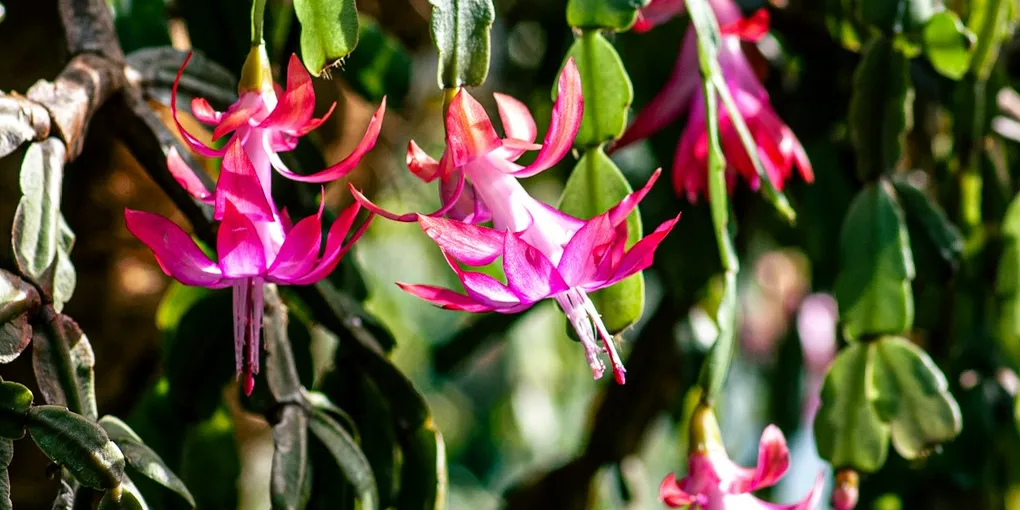
How to Care for a Thanksgiving Cactus
Thanksgiving cactus (Schlumbergera truncata) gets sold, gifted, and cared for almost interchangeably with Christmas cactus, and most of what ends up in stores in October and November is actually this species rather than its later-blooming relative. The easiest way to tell them apart is the leaf segments: Thanksgiving cactus has pointed, claw-like serrations along the edges, while Christmas cactus has softer, more rounded scalloped edges. Thanksgiving cactus also tends to bloom a few weeks earlier, around its namesake holiday rather than in December. Care for the two is nearly identical, and everything below applies whichever one you actually have.
Light
Bright, indirect light works best year-round. An east-facing window is close to ideal; a few feet back from a south- or west-facing window also works. Avoid intense direct sun through glass, which can scorch the flat segments. Insufficient light won’t kill the plant, but it will suppress flowering, so if a plant refuses to bloom, light is the first thing to check — see how much light do houseplants need for how to judge a spot.
Watering
Like its Christmas cactus relative, this is an epiphyte from humid forest, not a desert succulent, and it shouldn’t be treated like one. Let the top inch of soil dry out, then water thoroughly and let it drain. During the post-bloom rest period in late winter, ease off slightly and let it dry a bit more between waterings, but never let it go bone-dry for extended stretches — that’s a common cause of shriveled, limp segments and dropped buds.
Soil and pot
A well-draining mix that still holds some moisture works better here than a straight cactus mix — a standard potting mix cut with extra perlite gets the balance right; see the best soil mix for houseplants for ratios. Always use a pot with a drainage hole. This plant also blooms more reliably when slightly potbound, so avoid sizing up the pot unless roots are visibly crowded or circling.
Getting it to rebloom
Flowering on this plant is triggered by environment, not a fixed schedule, and getting the trigger right is the difference between blooms every autumn and a plant that never flowers. Starting about 6-8 weeks before you want flowers — early autumn is typical — give the plant 12-14 hours of complete, uninterrupted darkness every night, with bright indirect light during the day. Any stray light overnight, even a hallway light or streetlamp through a window, can disrupt the trigger. A closet, or simply moving the plant to a dark room each evening, works fine.
Cool nighttime temperatures, ideally in the 50-65°F (10-18°C) range, help set buds faster. Once buds appear, stop moving, rotating, or otherwise disturbing the plant, and keep watering consistent — changes at this stage are the most common reason buds drop before opening. For general feeding through the growing season, see how often to fertilize houseplants; ease off fertilizer once buds have set.
For a comparison of how flowering houseplants generally perform indoors, see best flowering houseplants to grow indoors.
Common problems
Bud drop right before blooming is the most common complaint. Usual causes: letting the soil dry out completely while buds are forming, moving or rotating the plant once buds have set, a sudden temperature swing near a draft or heating vent, or low humidity. Keep the routine steady once buds appear and resist repositioning the plant for a better view until after it flowers.
No blooms at all almost always comes down to a missed light and temperature trigger rather than a watering or feeding problem. If the plant gets any light overnight, even ambient room light, it may never set buds.
Shriveled, limp segments typically mean underwatering rather than overwatering, despite the “cactus” in the name — check whether the soil has been dry for more than a few days and adjust.
Mushy or blackened segments point to root rot from a pot that doesn’t drain or soil that’s stayed wet too long. Pull the plant, trim away affected tissue, and repot into fresh, well-draining mix.