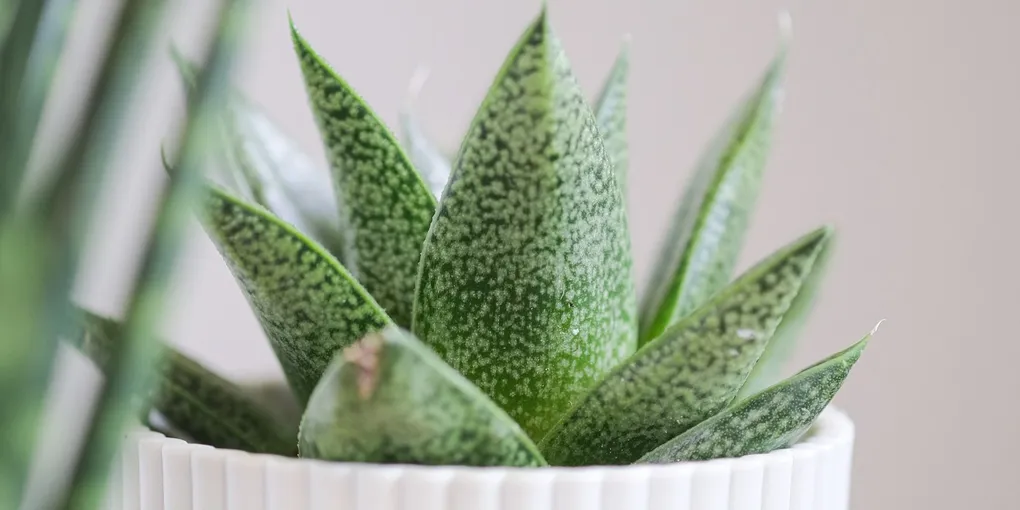
How to Care for a Gasteria (Ox Tongue Plant)
Gasteria is a genus of thick-leaved succulents closely related to aloe and haworthia, grown for its rough-textured, tongue-shaped leaves rather than for flowers or fast growth. Young plants typically produce leaves in a distinctive two-row, fan-like pattern (called distichous growth) before eventually spiraling into a looser rosette as they mature. It’s a slow grower and an easy one, and it tolerates lower light than most succulents people try to grow indoors.
Light
Gasteria is more shade-tolerant than the vast majority of succulents. Bright, indirect light is ideal, and unlike a lot of its succulent relatives, it doesn’t need direct sun to thrive — in fact, harsh direct sun can scorch its leaves, especially if the plant hasn’t been acclimated to it gradually. An east-facing window or a spot a few feet back from a bright south- or west-facing one works well. This makes it a solid choice for a room that gets good light but not much direct sun, somewhere a lot of other succulents would struggle.
Watering
Let the soil dry out fully between waterings, then water thoroughly. The thick leaves store water efficiently, so this plant can go a long stretch without watering and show no signs of stress. Water less often in winter when growth slows. As with most succulents, overwatering is the more common way to lose this plant — see how to care for succulents for the general watering approach this plant follows closely.
Soil and pot
A fast-draining cactus or succulent mix is essential, and a pot with a drainage hole is a must. Gasteria has a fairly shallow, modest root system, so it doesn’t need a large pot — sizing up only slightly when it outgrows its current one is enough, and an oversized pot just holds excess moisture around roots that don’t need it.
Humidity
Ordinary indoor humidity is fine. Gasteria comes from semi-arid parts of South Africa and doesn’t benefit from extra humidity the way a tropical plant would.
Toxicity
Gasteria is non-toxic to cats and dogs, which makes it a low-worry choice if you’re building a collection of pet-safe succulents around the house.
Common problems
Long, pale, stretched leaves reaching toward a light source signal too little light — even though this plant tolerates shade better than most succulents, it still needs consistent bright, indirect light to stay compact. Move it closer to a window.
Bleached, tan, or scorched patches on the leaves point to too much direct sun, especially after a plant that’s been in low light gets moved somewhere much brighter all at once. Ease it into stronger light gradually rather than making the move in one step.
Soft, mushy, or discolored leaves near the base usually mean overwatering or root rot. Let the soil dry out fully and check the roots; trim away any that are dark and mushy and repot into fresh, dry mix.
Slow or stalled growth is often just normal — Gasteria is a genuinely slow grower even in good conditions, so a lack of dramatic new growth isn’t necessarily a sign anything is wrong.
Small offsets forming at the base are a good sign of a healthy, established plant. These can be left in place to form a cluster or separated and potted individually once they have their own roots.
If you’re comparing light needs across succulents, haworthia is a similarly shade-tolerant, slow-growing relative with very close care requirements, while echeveria sits at the other end of the spectrum and needs much more direct sun to hold its rosette shape and color — a useful contrast if you’re deciding where to put each one.