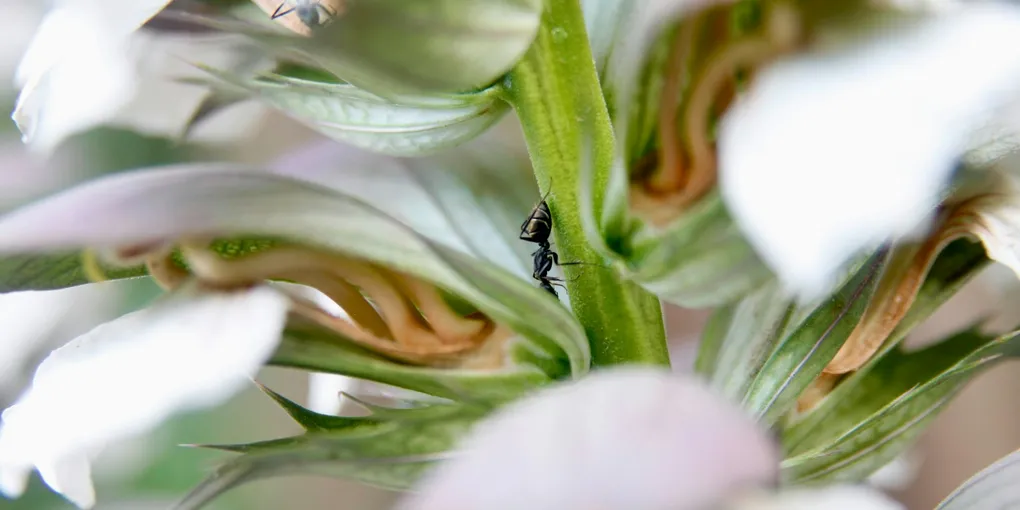
How to Get Rid of Ants on Houseplants
Ants rarely show up on a houseplant for no reason. Unlike most pests that damage a plant directly by feeding on it, ants are usually a symptom of something else going on — either they’ve moved into the potting soil to nest, or they’ve found a food source on the plant itself and are actively protecting it. Figuring out which situation you’re in changes how you fix it.
Why ants show up
They’re farming honeydew. Ants and sap-sucking insects like aphids, mealybugs, and scale have a well-documented relationship: those insects excrete a sugary waste called honeydew as they feed, and ants eat it. In exchange, ants will actively defend the colony producing it from predators and even carry aphids to fresh growth to keep the food supply going. An ant trail running up a stem is one of the more reliable early warning signs that one of these pests is already established, sometimes before the insects themselves are easy to spot.
They’ve nested in the pot. Potting soil that’s allowed to dry out repeatedly, especially in a pot kept outdoors part of the year, can look like a perfectly good nesting site to ants — loose, well-drained, and undisturbed. In this case the ants aren’t after the plant at all; they’re just using the pot as real estate.
How to tell which situation you’re in
Check the plant itself first, especially new growth, stem joints, and the undersides of leaves, for aphids, mealybugs, or scale — small, often stationary insects, sometimes with a sticky or waxy residue nearby. If you find them, the ants are farming. If the foliage looks clean but you see ants moving in and out of the soil itself, or notice small mounds of displaced soil at the surface, you’re dealing with a nest.
It’s possible to have both at once, since an established ant colony is more likely to go out and find sap-suckers to farm. If you’re unsure, treat both possibilities at the same time rather than guessing.
How to get rid of them
If it’s a farming situation, treat the underlying pest first. Ants will keep coming back for as long as there’s honeydew to collect, so spraying only the ants without addressing the aphids, mealybugs, or scale they’re tending won’t hold. Follow the treatment steps for whichever pest you’ve found — insecticidal soap or neem oil, applied thoroughly and repeated every 5-7 days, clears both the sap-suckers and, indirectly, the ants’ reason for being there.
If it’s a nest in the pot, soak the soil. A thorough soak — set the pot in a basin of water for 15-20 minutes — floods the nest and drives ants out far more reliably than a surface spray. Follow your usual routine afterward; see watering houseplants the right way if you’re not sure how much is too much for the plant itself.
Use bait stations for a persistent trail. Ant bait, placed near the base of the pot rather than directly in the soil, lets foraging ants carry poison back to the colony, which is more effective against an established nest than spraying visible ants on contact — killing the ants you can see does nothing to the rest of the colony.
Wipe away food sources. Clean any sticky honeydew residue off leaves and nearby surfaces once the underlying pest is under control, and keep the area around pots free of spilled soil, dead leaves, or anything else that might read as food to a scouting ant.
How to prevent them coming back
Inspect plants regularly for the early signs of aphids, mealybugs, and scale, since catching those pests before a colony builds up is the most reliable way to keep ants from taking an interest in the first place. Avoid letting soil dry out completely for extended stretches, especially for pots that spend time outdoors, since bone-dry soil is far more attractive to nesting ants than soil that’s watered on a regular rhythm. For the broader range of pests that show up on houseplants and how they differ from one another, see common houseplant pests and how to get rid of them.
An ant trail is rarely the whole story — treat it as a clue pointing you toward the real problem, and the ants themselves usually clear up once that underlying issue is resolved.